
Watch the Henri Cartier-Bresson documentary ‘L’amour de court’ (‘Just plain love’, 2001) available in five parts on YouTube:
http://www.youtube.com/playlist?list=PL707C8F898605E0BF
Write a personal response to the film in the contextual section of your learning log, taking care to reference properly any quotations you use (300–500 words).
L’amour de court.
Henri Cartier-Bresson was a humanist photographer, he was born in Chateloup-en-Brie in France in 1908. He came from a wealthy left wing Catholic family and was well educated. L’amour de court was a documentary made about him in 2001 when he was 92 years of age.
His life was very colourful, he talked openly about visiting the local brothel with his friends. He even told his mother that “the conversations there are more interesting than in your sitting room” Cartier-Bresson H (1908 – 2004), his mother tirelessly campaigned to close the brothels.
He travelled extensively, he lived a few years in the Far East and also spent some time in Africa in the Commandos. He ended up in jail there after being caught absconding, he was put in a lockup for two weeks and spent three months in a disciplinery facility before being sent back to his unit.
In this documentary he came across a very interesting, charming man with a glint in his eye. When talking about his photography, he said “what matters is to look, most of them don’t look, they press the button, they identify, but to seek the meaning beyond this or this (He pointed to certain facial features to emphasise his words), very few do it, what matters is to look” Cartier-Bresson H (1908 – 2004).
“What’s does the eye seek out?” he asked, “it’s a question mark”.
“You have to be receptive that’s all, like the relationship between things, if you want it you get nothing, just be receptive and it happens” Cartier-Bresson H (1908 – 2004).
Framing is an important aspect of his Photography. You can see this throughout his work, in the geometry, divine proportions and physical rhythm.
Henri Cartier-Bresson was an observer. He watched and was always on the lookout and ready to react to capture a moment, unlike others who were distracted and unobservant.
Henri Cartier-Bresson was a very empathetic man who seemed to feel the pain and emotion of every situation he photographed, this would make him almost invisible in the eyes of the subjects he captured. He even painted the chrome parts of his Leica camera black to remain unnoticed while shooting his images.
He had an eye for capturing an instant, recording a memory. Could we learn to see? That was a question he asked. After spending time with a sound engineer, he said he learnt what it meant to listen, but he said “I still look” Cartier-Bresson H (1908 – 2004).
Could we learn to “see”? Is it possible to be taught how to “see” in photography? There are many different techniques to teach us how to “see”, there’s the rule of thirds, focal points, framing and many more. So l believe you can learn to a degree.
One of Henri Cartier-Bresson’s most famous images was taken when he slipped the camera in between planks of wood. Only the lens went through, and although he couldn’t see what was on the other side, he shot the image anyway. It was called behind the Gare Saint-Lazare, Paris 1932, and he said “this photograph was a matter of chance, that was lucky, its always luck, its luck that matters” Cartier-Bresson H (1908 – 2004).
Whilst I believe that there is an element of luck when capturing an image, I don’t believe all his images were taken purely by chance. It was said by Sean O’Hagen from the Guardian that “Cartier-Bresson always emphasised the importance of composition, and liked to “instinctively fix a geometric pattern into which a chosen subject fitted. The idea that he lay in wait for someone to walk into a precomposed frame may explain his extraordinary hit rate” O’Hagen S (2014). I tend to agree with Sean although I’m sure Henri Cartier-Bresson would disagree with this.
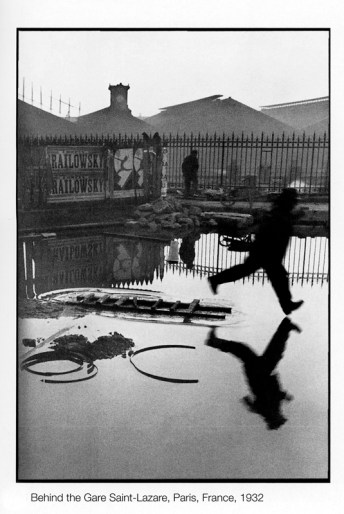
Henri Cartier-Bresson produced a book called the “decisive moment”, and this book became his most famous. But what is the “decisive moment”? There have been many debates and different opinions on the subject, I asked my colleagues for their definitions and interpretations, and the general consensus was that it was a significant moment in time or making a life changing decision. I pondered this myself. My definition for photography purposes is capturing a natural moment in time that’s not staged or manipulated. The “decisive moment” in this era of digital photography isn’t deemed as being important anymore due to the ability to alter images with software or create staged photography, however I disagree with this view. Garry Winograd said “The decisive moment has come to mean the perfect second to press the shutter”. “In this context, it might be better applied to” Winograd G (1928-84). He was a street photographer who liked to capture expressions.
As Henri Cartier-Bresson reminisced about his life and all his antics, I could sense in his facial expressions that he wouldn’t have changed a thing.
Give some careful thought to the ‘decisive moment’ debate and note down where you stand (at the moment, anyway) in your learning log.
Thoughts on the ‘decisive moment’.
After researching Henri Cartier-Bresson for the research point in this chapter, I can see how important this term can be when sport or street photography is your genre. You have to capture that expression or stance in an instant. The ‘decisive moment’ in those images are in real time, as its happening, without staging or pretence.
Henri Cartier-Bresson’s work did show us that the ‘decisive moment’ can capture stunning images, although he was a master of this technique. Or was he simply just lucky?
Another ‘decisive moment’ photographer was Charles Hoff, he photographed a lot of boxing bouts, he had a natural ability of capturing that heavy blow or that moment just as the fighter was about to hit the canvas. He also captured the explosion of the Hindenburg in 1937. It took 47 seconds for the airship to be destroyed, Charles Hoff only took one image which was published worldwide.
Created in 1952 by photographers and writers, Aperture is a centre for the photo community. In Aperture’s new exhibition, Photography is magic, curator Charlotte Cotton asked a group of the artists: “In experimental photography, is there ever a decisive moment?” Cotton C (2016). Their interpretation and relevance of the decisive moment was very varied.
Hyounsang Yoo said “I think artists and photographers interpret their own way to make a decisive moment. My work is often heavily manipulated, staged, and stripped of contextual information. I do not take a photographs; I make them” Yoo H (b1986).
Valerie Green said “The ‘decisive moment’ in my work expands beyond Bresson’s notion of the ‘creative fraction of a second.’ I utilize both chance and choice to capture not only a singular moment, but a multitude of moments that are layered on top of each other” Green V (b1981).
Anastasia Samoylova said “The ‘decisive moment’ is a beautiful fiction: the idea that a single decision of the artist is responsible for the creation of the picture. Each set that I photograph takes hours of pre-conceptualization and physical construction, yet is captured in a fraction of second—right before everything falls apart” Samoylova A (b1984).
What is my opinion of the ‘decisive moment’? I consider it is to be an important element in photography, as every good photographer is always looking to perfect the skill of hitting the shutter button at exactly the right time, especially if there is movement within the frame.
Is the ‘decisive moment’ as important within static genres of photography? I concluded from my research that these days with digital photography and post production software, the term is less relevant.
However, there are may other principles just as important to be taken into consideration.
I found it interesting to read different photographers diverse perception of their ‘decisive moment’.
I’m sure the debate regarding the importance of this term in photography will always be challenged.
 Jo's Photo Blog